Another useful City resource for Owners and Architects are the Tax Photographs available from the NYC Municipal Archives. Between 1939 and 1941, and again in the mid-1980s, the city photographed every house and building in the five boroughs. These photos are now available for purchase from NYC.
To obtain a copy, you can go to the Archives in person (31 Chambers Street, NY, NY-check their web site for hours and details before going), or you can order a copy online.
Here's a link to the web page, which explains more about the history of the photos and has instructions for ordering online: NYC.GOV/RECORDS
The Tax Photo might be useful for permitting purposes:
This resource may be helpful to illustrate an existing non-compliance to remain to a DOB Plan Examiner, such as a projecting stoop that may require reconstruction.
Have a question? E-mail Permitadvisor
Sunday, September 27, 2009
Tax Photographs of Buildings from the NYC Municipal Archives
Friday, September 11, 2009
HPD I-Cards Available Online
Check out the HPD I-Card for the building, now available for free download on the HPD Website.
This is a great way to get useful historical information for Multiple Dwellings in the City. This comes in especially handy for old buildings with little or no DOB Actions/Filings, which I commonly find to be the case for brownstones in Brooklyn.
You might need this information if you need to prove the existing legal use/occupancy of a building. Or, if you need to know the Multiple Dwelling Classification of an old building.
Sometimes there are even schematic plans of the building on the I-Card, which can be useful in proving the 'Existing Legal Layout' of an unaltered building to a Plan Examiner when no DOB-approved plans are on file.
Follow these steps:
Go to the HPD Website Home Page
Enter the address of the property in the light blue search box:
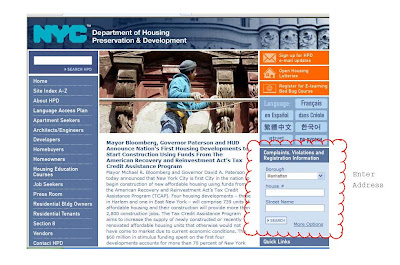 If the property is found in HPD's Database, there will be a series of links listed on the left side of the page. Towards the bottom, there is a link 'I-Card Images'. Click on it:
 If an I-Card is found, it will be listed towards the bottom of the page with a link that says 'View'. Click on it. You may need to install a plug-in when prompted:

That's it, you should see the I-Card, which you can print on your printer, or print to Adobe PDF & save to your computer.
Have a question? E-mail Permitadvisor
Thursday, September 10, 2009
Emergency Escape and Rescue Openings for Residential and Institutional Occupancies
Emergency Escape and Rescue Openings are required in the New NYC Construction Code as per Section BC 1025 in R (Residential) and Group I-1 (Institutional) Occupancies.
Sleeping Rooms below the fourth story above grade shall have at least one emergency escape and rescue opening.
Where below-grade stories contain one or more sleeping rooms, emergency escape and rescue openings shall be required in each sleeping room and shall open directly in to a public street, public alley, yard or court.
- The minimum size of such openings is a minimum net clear opening of 6 square feet.
- The net clear opening height dimension shall not be less than 30"
- The net clear opening width dimension shall not be less than 24"
- The bottom of the clear opening shall not be more than 36" above the floor.
- The opening shall be operational from the inside of the room without the use of keys or tools.
- An emergency escape and rescue opening below the adjacent ground level shall be provided with a window well with a minimum horizontal area of 9 Sq Ft, with a minimum dimension of 36".
- Window wells with a depth of more than 44" shall be equipped with an approved permanent ladder or steps.
There are exceptions listed in the Code under Section 1025.1. The above is an abbreviation/summary of the full Code requirement. Please refer to the Building Code Text for full details.
Have a question? E-mail Permitadvisor
Tuesday, September 08, 2009
2008 Occupancy Group Classifications
Below is a list comparing the 1968 Building Code Occupancy Group Classifications to those of the new NYC Construction Codes
The 1968 Code classified Occupancies in decending order from higher to lower hazard in terms of Life Safety. The 2008 Code classifies Occupancies according to logical reference, where the Occupancy Group Letter matches the Description (ex: R=Residential)
1968 Code -->2008 Code
A-High Hazard-->H-High Hazard (H-1 thru H-5)
B-Storage-->S-Storage (S-1 & S-2)
C-Mercantile-->M-Mercantile-Display and Sale of Merchandise
D-Industrial-->F-Factory and Industrial (F-1 & F-2)
E-Business-->B-Business (Office, Professional, Service-type transaction, Public or Civic Services)
F-Assembly-->A-Assembly (A-1 thru A-5)
G-Education-->E-Educational (5 or more persons)
H-Institutional-->I-Institutional (I-1 thru I-4)
J-Residential-->R-Residential (R-1 thru R-3)
K-Miscellaneous-->U-Utility and Miscellaneous (Accessory Structures or not classified in any specific occupancy)
Description of 2008 Sub-Occupancies:
Assembly:
A-1=Assembly with Fixed seating, intended for production and viewing of the Performance Arts or Motion Pictures.
A-2=Food and/or Drink Consumption.
A-3=Worship, Recreation or Amusement (Physically active), and other assembly uses not classified elsewhere in Group A.
A-4=Indoor Sporting Events with Spectator Seating.
A-5=Participation in or viewing Outdoor Activities.
Factory and Industrial (F):
F-1=Moderate Hazard.
F-2=Involves Non-Combustible, Non-Flammable Materials, or Low-Hazard Production.
High Hazard (H):
H-1=Materials that present a Detonation Hazard.
H-2=Uses Present a Deflagration Hazard or a Hazard from Accelerated Burning.
H-3=Materials that readily support combustion or present a Physical Hazard.
H-4=Materials that are Health Hazards.
H-5=Semiconductor Fabrication Facilities using excessive Hazardous Production Materials (HPM) in excess of the permitted aggregate quantity.
Institutional (I):
I-1=Housing persons, on a 24-hour basis, capable of self-preservation and responding to an emergency situation without physical assistance from staff.
I-2=Medical, Surgical, Nursing, or Custodial Care, on a 24-hour basis, of more than 3 persons who are not capable of self-preservation or responding to an emergency situation without physical assistance from staff.
I-3=More than 5 persons who are detained under restraint or for security reasons.
I-4=Day Care Facilities occupied by persons of any age who receive custodial care (without overnight) by individuals other than parents, guardians, or relatives in a place other than home.
Residential (R):
R-1=Residences occupied Transiently (for less than 1 Month).
R-2=Residences containing more than 2 Dwelling Units and occupied on a Long term basis (for a month or more).
R-3=Residences containing not more than 2 Dwelling Units and occupied on a Long term basis (for a month or more).
Storage (S):
S-1=Moderate Hazard Storage Occupancy for any Flammable or Combustible Materials.
S-2=Low Hazard Storage Occupancy for Non-Combustible Materials.
This list is for informational purposes only. Refer to the 2008 Code Text for the official reading.
Also see the DOB Fact Sheet
Have a question? E-mail Permitadvisor
Tuesday, April 01, 2008
Scissor Stairs

A: A Scissor Stair is a set of 2 interlocking stairways providing two separate paths of egress located within one stairwell enclosure. The Stairs wind around each other, and are separated from each other within the enclosure, by fire rated construction having the same rating as the Stair Enclosure (usually 2-hour construction). Scissor Stairs are permitted under certain conditions by the New NYC Construction Code, as listed below.
Scissor stairs are particularly effective in small footprint Residential Apartment buildings requiring 2 vertical means of egress. In large footprint buildings, Scissor Stairs may create Dead End Corridors, and should be avoided.
Scissor Stairs are permitted in:
'J-2' Residential Apartment Buildings ('R-2' New Const Code).
Per New Construction Code Section 1014.2.1:
- Stair doors must be at least 15 feet apart from each other
- Stair Enclosing Walls shall be Constructed of 2-Hr rated Masonry or approved Masonry Equivalent material.
- Stair may share common walls, floors, ceilings or scissor stairs assemblies or other enclosures provided that the construction separating the stairs is also of at least a 2-hour fire resistance rating and constructed of masonry or masonry equivalent.
- Author’s Note: Comply with Dead End Corridor limitations.
- Author’s Note: Both Stairs within the Scissor Stair enclosure must extend to the Roof to provide Roof Access.
- Author’s Note: When both of the Stairs within a Scissor Stair terminate at a Street Floor Lobby, egress must be provided in 2 separate directions from the Lobby to the Street.
'E' Office Buildings ('B' New Const Code)
Per New Const Code Requirements Section 1014.2.1:
- With a Building Height not exceeding 60 feet
- With a Footprint not exceeding 2,000 sq ft per floor
- Stair doors shall be at least 15 feet apart from each other
- Maximum travel distance of 50 feet from most remote point to a Stair Door
- Stair Enclosing Walls shall be Constructed of 2-Hr rated Masonry or approved Masonry Equivalent material
- Stair may share common walls, floors, ceilings or scissor stairs assemblies or other enclosures provided that the construction separating the stairs is also of at least a 2-hour fire resistance rating and constructed of masonry or masonry equivalent.
Saturday, March 29, 2008
Minimum Trap/Waste Outlet Sizes for Plumbing Fixtures
Q: What are the Minimum Trap/Waste Outlet Sizes for Plumbing Fixtures, the the NYC Building Code?
A: Refer to Table 16-6 for the Minimum Trap Sizes, as restated below:
Fixtures & Trap Sizes:
Bathtub (with or without overhead Shower 1 1/2"
Bidets 1 1/2"
Combination Sink and Wash (Laundry Tray) 2"
Dental Unit or Cuspidor 1 1/2"
Drinking Fountain 1 1/2"
Dishwasher, Commercial 2"
Dishwasher, Domestic 1 1/2"
Floor Drain 3"
Funnel Drain 1 1/2"
Kitchen Sink, Domestic 2"
Laboratory Cup Sink 1 1/2"
Laboratory Sink 2"
Lavatory, Common 1 1/2"
Lavatory, Barber, Beauty Parlor, or Surgeon's 1 1/2"
Lavatory, multiple type (was fountain or sink) 1 1/2"
Laundry Tray (1 or 2 compartments) 1 1/2"
Laundry Standpipe 2"
Shower, Stall 2"
Shower, Gang 3"
Sink (Surgeon's) 1 1/2"
Sink (flushing rim type, flush valve supplies) 3"
Sink (service type with Trap Standard) 3"
Sink, Commercial (Pot, Scullery or sim) 2"
Sterilizers 3"
Urinal (Pedestal) 3"
Urinal (Stall Type) 2"
Urinal (Wall Lip Type) 2"
Urinal (Women's) 3"
Water Closet (Waste Outlet) 3"
Have a question? E-mail Permitadvisor
Wednesday, February 06, 2008
When is a Work Permit Required?
Q: When exactly is a Work Permit required from the NYC Department of Buildings for construction work?
A: The Code allows 'Minor Alterations' and 'Ordinary Repairs' to buildings without the need to obtain a Work Permit provided that it meets their definition of same.
Minor Alterations and Ordinary Repairs do not include the following and therefore require the issuance of a Work Permit:
- Cutting away of any portion of a wall, floor, or roof construction.
- Removal, cutting, or modification of any beams or structural supports.
- Removal, change, or closing of any required means of egress
- Rearrangement or relocation of any parts of the building affecting loading or exit requirements
- Alterations, modifications, replacements, repair or removal of Sprinkler or Standpipe systems.
- Alterations, modifications, replacements, repair or removal of Plumbing or Sewer systems. However, replacement of Plumbing Fixtures on existing Roughing from the inlet side of a trap to any exposed stop valve does not require a Permit.
- Any other work affecting health or the fire or structural safety of the building.
ARTICLE 5 MINOR ALTERATIONS: ORDINARY REPAIRS
27-124 Minor alterations
For the purposes of this code, the term "minor alterations" shall mean minor changes or modifications in a building or any part thereof, excluding additions thereto, that do not in any way affect health or the fire or structural safety of the building. Minor alterations shall not include any of the work described or referred to in section 27-126 of this article, or any other work for which a permit is required under the provisions of articles ten through seventeen of this subchapter.
27-125 Ordinary repairs
For the purposes of this code, the term "ordinary repairs" shall mean replacements or renewals of existing work in a building, or of parts of the service equipment therein, with the same or equivalent materials or equipment parts, that are made in the ordinary course of maintenance and that do not in any way affect health or the fire or structural safety of the building or the safe use and operation of the service equipment therein. Ordinary repairs shall not include any of the work described or referred to in section 27-126 of this article or any other work for which a permit is required under the provisions of articles ten through seventeen of this subchapter.
27-126 Work not constituting minor alterations or ordinary repairs.
(a) For the purposes of this code, minor alterations or ordinary repairs shall not include the cutting away of any wall, floor, or roof construction, or any portion thereof; or the removal, cutting, or modification of any beams or structural supports; or the removal, change, or closing of any required means of egress; or the rearrangement or relocation of any parts of the building affecting loading or exit requirements, or light, heat, ventilation, or elevator requirements; nor shall minor alterations or ordinary repairs include additions to, alterations of, or rearrangement, relocation, replacement, repair or removal of any portion of a standpipe or sprinkler system, water distribution system, house sewer, private sewer, or drainage system, including leaders, or any soil, waste or vent pipe, or any gas distribution system, or any other work affecting health or the fire or structural safety of the building.
(b) Minor alterations or ordinary repairs shall include the repair or replacement of any fixture, piping or faucets from the inlet side of a trap to any exposed stop valve.
Have a question? E-mail PermitadvisorLandmarks Expedited Review
Q: What is the criteria necessary to file for a Landmarks Expedited Review Permit?
A: Landmarks Approval for construction projects can add significant lead time to issuance of a Work Permit. Landmarks offers an Expedited Review process for Alterations meeting the below criteria. We encourage all applicants that can comply with the criteria to submit their application using this method:
1. Must be INTERIOR WORK ONLY;
2. Must be performed ONLY ABOVE THE SECOND STORY;
3. Must NOT be performed on any portion of a space designated as an interior landmark;
4. Must NOT involve any change to, replacement of, or penetration of any window, skylight,
exterior wall or roof of any portion thereof; and
5. For floors 3 through 6 must NOT involve a dropped ceiling or a partition which is less than a
minimum of 1'-0" back from any interior windows sill or frame, whichever is further from the
glass.
Have a question about Landmarks Permits? E-mail Permitadvisor
Friday, November 16, 2007
Asbestos ACP-5 Exemptions
 Replacement of a Rooftop Air Conditioner with no change to Ductwork is exempt from the filing of an Asbestos Report ACP-5.
Q: I am filing my alteration with the NYC Department of Buildings for Permit Issuance. Are there any types of alterations that are exempt from the filing of an ACP-5 Asbestos Report? If so, what is the list of exempted items?
A: As per a previous post, Buildings filed with the DOB after April 1, 1987 do not require an Asbestos Investigation (ACP-5). In addition, the following items are exempt:
Accessory Parking
Awnings
Building-Sealing
Candy or News Stands
Change of Use, Legalization, or Certificate of Occupancy requiring No Work
Concrete Work (Exterior)
Cranes
Curb Cuts
Debris Chutes, where chute will not be used for Asbestos-Containing Materials
Demolition of 1 story Garages, maximum capacity 2 cars, NOT supplied with Water Lines
Dumbwaiter-Sealing
Elevator Equipment (not including construction and enclosure of Elevator Shaft)
Emergency Power NOT involving hard wiring (i.e. Battery Packs)
Finish Material Installation
Fire Escape Installation
Flagpoles
Greenhouses-Detached
Hoist
Interior Non-Bearing Partition Installation involving NO penetration of Hung Ceiling
Kiosks
Legalization of Demolition Work which occurred prior to 4/1/1987
Parapet Walls
Radio Antennas (Towers)
Relocating Parking Lot Sheds
Retaining Walls
Roof Decks not anchored to Building Structure
Rooftop Air Conditioning Replacement, not involving modification or Removal of Duct Work
Scaffolding (Exterior)
Sidewalk Cafes
Sidewalk Elevators
Sidewalk Sheds, Bridges, and Fences
Signs
Storefront Installation in Existing Masonry Openings
Subdivision of an existing Tax Lot
Temporary Structure Erection (trailers, shanties, etc), supplied with Electric and Water Lines only
Tents
Underpinning of Buildings
Vaults
Water Tank Replacement (Exterior)
Zoning Lot Reapportionment
This information was compiled from DOB OPPN's 1/87, 10/87, and 1/88.
Have a question? E-mail Permitadvisor
Tags:
Saturday, November 10, 2007
Deck in a Rear Yard?
 Above is a view into typical Brooklyn Brownstone rear yards, showing many decks and roof coverings constructed of combustible materials. Often, these structures have not been constructed legally.
Q: What are the legal requirements for the construction of a Deck in the Rear Yard of a Brownstone-type building?
A: When considering construction of a Deck, it is necessary to comply with the Department of Buildings requirements for Decks. Legalization of existing Decks can be problematic, because many have not been designed by an Architect or Engineer and no Permit was ever obtained. The NYC Department of Buildings is cracking-down on Deck requirements, as they can be hazardous from a structural or fire safety standpoint when constructed improperly. An Illegal Deck can also be a problem when selling a property or applying for a Certificate of Occupancy.
Below is a listing of the basic Deck requirements, distilled from NYC Department of Buildings Memorandums. New Decks would need to comply with the below in order to obtain Plan Approval. Existing Decks needing to be Legalized would have to be modified (as required) to comply with the below:
A Deck is a raised floor, supported by structural framing above the surrounding ground at the level of the first story of a house. A Deck must be constructed without a roof. An outdoor structure with a roof is not a Deck. It may be considered an additional room, in which case different zoning rules and NYC Building Code provisions will apply.
Deck Requirements:
1 Only a NYS Registered Architect or Professional Engineer may design a Deck or porch. The Department of Buildings must approve the plans and issue a permit before any work begins.
2 Decks must be located at or below the floor level of the first story of a house.
3 A Deck may project up to eight feet (8’) beyond the face of the building into the required thirty foot (30’) rear yard.
4 There shall be no useable building or storage space underneath the Deck.
4 There must be at least three feet (3’) between the Deck and the SIDE or REAR LOT LINE, unless the Deck is constructed of non-combustible materials, such as steel, in which case it may be closer to the Property Lines.
5 All Decks must have a railing at least 42 inches high.
6 Spaces between railings and/or posts can be no greater than five inches.
7 Elevated Decks must be braced at the columns and where the beams and columns connect.
8 Decks must be able to withstand a minimum of 40 pounds per square foot plus the weight of the Deck. This is the same live load required as for the building itself. Thus, a Deck will usually require a structure as robust as that of the main house’s floor construction, rather than the flimsy, under-structured wood Decks that are commonly seen.
9 Decks must be properly anchored to a house or building. Nailing Decks instead of using proper anchors is a common mistake that often leads to accidents and can cause serious injuries.
10 A homeowner may construct a Deck, but is not allowed to perform plumbing or electrical work. If you use a contractor, the contractor must have a Home Improvement Contractor’s License.
Thursday, November 08, 2007
What is a Revocable Consent?

A: When a Building Owner wishes to construct a portion of their building beyond the Front Lot Line or Street Line, they may be required to obtain a Revocable Consent approval to do so.
The Building Code allows certain, limited projections beyond the Street Line, for both above-ground and below-ground projections. These are covered in 1968 Building Code Subchapter4, Articles 8 & 9. See my entry on Projecting Balconies as an example of a permissible projection not requiring a Revocable Consent.
If, however, the Building Owner wishes to construct beyond the limitations specified in the Building Code, they will need to apply for a Revocable Consent through the NYC-Department of Transportation.
A Revocable Consent is a grant by the City to construct and maintain certain structures on, over, or under City Property (usually the Sidewalk or Street). As the name implies, the City may revoke the grant at any time, and thus oblige the Owner to remove the projection.
The Revocable Consent process takes approximately 4-6 months, longer if a Uniform Land Use Review Procedure is required (ULURP). The ULURP Process adds at least 6 months to the process.
Generally, consents are granted for a term of ten years, at the end of which time they may be renewed. Revocable Consents are distributed to several reviewing agencies, all of which must approve the petition:
-Borough President's Office
-DOT Borough Commissioner
-Department of Environmental Protection
-Department of Buildings
-Art Commission
-Local Community Board
-City Council
-Department of City Planning (for ULURP)
A few examples of structures that commonly require Revocable Cosents:
-A Building Cornice projecting more than 10" beyond the Property Line.
-An Outdoor Bench on the Sidewalk
-An Information Kiosk
-Building Steps or Entrance Details which project more than 18" beyond the Property Line
-Exterior Wheelchair Ramps installed on an existing building which project more than 44" beyond the Property Line.
-Canopies, exceeding the size limitations of a standard Canopy.
Tuesday, November 06, 2007
Where are Portable Fire Extinguishers required?

Q: In what Occupancies are Portable Fire Extinguishers required?
A: The following information is to the best of my knowledge, and may have been updated or revised. In addition, there may be some special Occupancies where portable fire extinguishers are required that are not listed below (for instance, at Outdoor Sidewalk Cafes with Gas Heaters) However, the below list is a good starting point:
As per SECTION 15-02 OF TITLE 3 OF THE RULES OF THE CITY OF NEW YORK,
"The owner or occupant of any occupancy or space shall ensure that such occupancy or space is equipped with the portable fire extinguishers as set forth in NFPA Standard 10-1998, except as otherwise required by this subdivision. The NYC FIRE DEPARTMENT may prescribe such other or additional portable fire extinguisher requirements as it determines to be necessary for fire protection purposes, based on the use or configuration of the occupancy or space.
Portable fire extinguishers shall be provided in the following occupancies or spaces:
1. Occupancies or spaces used or classified as OFFICES or PLACES OF WORSHIP, HOTELS and MOTELS shall be provided with one fire extinguisher of minimum 2-A rating for every six thousand (6,000) square feet of floor area or fraction thereof on each floor, except that such a fire extinguisher shall be provided for every twelve thousand (12,000) square feet of floor area or fraction thereof on each floor for occupancies or spaces used as or classified as offices or places of worship in fully sprinklered buildings.
2. ROOMING HOUSES and SINGLE ROOM OCCUPANCIES, as defined in the New York State Multiple Dwelling Law, with over 15 sleeping rooms shall be provided with one fire extinguisher of minimum 2-A rating in the apartment of the manager or the building superintendent.
3. HOSPITALS, NURSING HOMES, HOMES FOR THE AGED, DAY NURSERIES accommodating more than 15 children and asylums shall be provided with one fire extinguisher of minimum 2-A rating for every 2,500 square feet of floor area or fraction thereof on each floor.
4. Places of PUBLIC ASSEMBLY or other occupancies or spaces where 75 or more people congregate, including places for entertainment or amusement, shall be provided with one fire extinguisher of minimum 2-A rating for every 2,500 square feet of floor area or fraction thereof on each floor.
5. Occupancies used or classified as RETAIL STORES or shops shall be provided with one fire extinguisher of minimum 2-A rating for every 2,500 square feet of floor area or fraction thereof on each floor.
6. PIERS, STABLES, WAREHOUSES, MANUFACTURING occupancies and all COMMERCIAL occupancies except stores and office buildings shall be provided with one fire extinguisher of minimum 2-A rating for every 2,500 square feet of floor area or fraction thereof on each floor.
7. Occupancies or spaces used or classified as LUMBER YARDS shall be provided with one fire extinguisher of minimum 2-A rating for every 2,000 square feet of floor area or fraction thereof
8. Occupancies or spaces used or classified as TELEPHONE EXCHANGES shall be provided with portable fire extinguishers suitable for Class A and Class C fires. A fire extinguisher of a minimum 2-A rating shall be provided for every 3,000 square feet of floor area or fraction thereof.
9. STORAGE GARAGES, ELECTRIC POWER PLANTS and occupancies or spaces that manufacture, use or store flammable liquids or mixtures, combustible liquids or mixtures, fats, paints, waxes or similar substances shall be provided with an extinguisher suitable for a Class B fire that shall meet the rating and travel distance requirements for Extra (High) Hazard occupancies as specified in Table 3-3.1 of NFPA Standard 10-1998.
KITCHENS (except those used domestically in residential occupancies, but including those kitchens used communally by the occupants of more than one dwelling unit), shall be provided with an extinguisher suitable for a Class K fire, and shall meet the travel distance requirement of §3-7.2 of NFPA Standard 10-1998. The requirements of sub-paragraph 9 shall be in addition to sub-paragraphs 1-8 of this paragraph."
Contact FDNY with any specific questions, or visit the FDNY Web Site for further information.
Have a question about Fire Extinguishers? E-mail Permitadvisor
Tags:
Monday, November 05, 2007
What is an As-of-Right Development?
Q: What is an As-of-Right Development?
A: An AS-OF-RIGHT development is a DEVELOPMENT which complies with all applicable zoning regulations and does not require any discretionary action (special permit or variance) by the City Planning Commission or Board of Standards and Appeals for approval.
The significance is as follows:
A Developer acquires a vacant, 2,000 sq ft ZONING LOT in a Residence District which has a Maximum FLOOR AREA RATIO (FAR) of, say 4.0.
To determine the maximum ZONING FLOOR AREA that may be developed on the site, we multiply the LOT AREA (2,000 sq ft) x Maximum FAR (4.0), and we get 8,000 square feet.
When the Developer's Architect files the CONSTRUCTION DOCUMENTS with the NYC Department of Buildings for Plan Approval, the Architect illustrates the above FAR Calculation in his Zoning Analysis.
The NYC Department of Buildings Plan Examiner reviews the plans and finds that the development complies with the applicable FAR requirements. Assuming that the project complies with all other Code and Zoning regulations, the DOB Plan Examiner may APPROVE the Plans, and the Developer may construct the 8,000 sq ft building as-of-right.
It is not necessary for the Developer to seek the additional approval of the City Planning Commission, or of the Local Community Board, or of any other outside party of interest. His development complies with the applicable Zoning Laws currently in force, and he is entitled to build.
There are stories about over-development and upset neighbors witnessing new construction that they find bothersome or too large. Sometimes, it is true, an unscrupulous Developer or Architect has abused the DOB's PROFESSIONAL CERTIFICATION* program or exploited a COMMUNITY FACILITY FAR (when the building is not a Community Facility) or has pulled some other 'fast one' that the DOB is likely to catch. But often, the Development is as-of-right.
-For Residents concerned about over-development, gain an understanding of the Zoning Regulations for your District and lobby your Lawmakers to change the Zoning Regulations. Targeting the Developer will not be fruitful if the development complies as-of-right, the plans are approved, and a Work Permit has been issued.
-For Developers, it would usually be unwise not to maximize the potential Zoning Floor Area of the development site.
*Banks often do not accept plans approved under Professional Certification for development financing.
Have a Zoning question? E-mail Permitadvisor
Tags:
Sunday, November 04, 2007
Fire Escapes as a Means of Egress?

Have a question about Fire Escapes? E-mail Permitadvisor
Friday, November 02, 2007
DOT Permit Holiday Embargo

A: See below excerpt from the DOT Website. Refer to the Attachment for Streets affected by the DOT Holiday Embargo :
"2007 Holiday Construction Embargo - This embargo applies to NYCDOT Construction Permits.
A special construction embargo is in effect Friday, November 16, 2007 from 6AM to 11:59 PM and from Tuesday, November 20, 2007 6AM through Wednesday, January 2, 2008 11:59PM for the 2007 Holiday Construction Embargo. There will be strict enforcement of this embargo and violators are subject to be
summonsed.
Street and sidewalk construction will be restricted from 6:00 AM to midnight during the upcoming holiday season on the roadways listed below. Any permits issued prior to the date of this notice for work in the areas listed for the Holiday Embargo which do not already have the Embargo Waiver traffic stipulation "410" are hereby voided for the period of Friday November 16, 2007 from 6AM to 11:59 PM and from Tuesday November 20, 2007 6AM through Wednesday January 2, 2008 11:59PM. The permits will be in effect again on January 3, 2008.
All permittees must comply with this embargo unless a special waiver is granted by OCMC. Waiver requests must be filed by November 9, 2007 with the Permit Office by filing a "Request for Roadway/Sidewalk Permits During Embargo Periods" with supporting documentation. Work may only occur from 12:01 AM to 6:00 AM with the issuance of the necessary permits, no Embargo Waiver request is needed for work during these times. Waiver requests should only be submitted for critical reasons for a specific project. If a waiver is granted, you will be notified
to apply for the approved permits.
Necessary measures must be taken to ensure that all streets and sidewalks are in proper condition to allow for the expeditious and safe movement of vehicular and pedestrian traffic. OCMC will also impose similar restrictions on public utilities and private contractors for those roadways that are listed below by borough. Tool carts, cable reels, containers, and material stored on roadways must be removed during the embargo period. Utility cover openings are prohibited on roadways noted below between the hours of 6:00 AM and midnight unless the utility or contractor can prove an emergency exists.
Notice to All Permit Applicants:
Please note that this year, in accordance with § 4. Subdivision (m) of section 2-02 of Title 34 of the Rules of the City of New York which reads "A request for approval to work during an embargo shall be submitted on a form provided by the Commissioner, along with a fee ($135.00) as specified in §2-03 of these rules. Payment of the application fee shall not guarantee that approval to work during the embargo period will be granted and application fee is in addition to any required permit fees".
A copy of the form "Request for Roadway/Sidewalk Permits During Embargo Periods" is attached. All forms must be filed with the required documents (shown on the form) along with the required fee at our Permit Office, 220 Church Street Ground Floor by Friday, November 9, 2007. Waiver requests should only be presented for critical reasons related to your specific project."
Wednesday, October 31, 2007
Intumescent Paint for Fire Protection

A: Intumescent means "swelling and charring when exposed to flame". When exposed to fire, the coating will rapidly react, becoming a compact foam, dense carbon char, or similar, to stop fire migration.
Intumescent Paint products must have an MEA (Materials and Equipment Acceptance) Number to qualify as an approved means of rating structural members. The paint must be applied and utilized in a manner consistent with the MEA Approval.
MEA Numbers for Intumescent Paint may be verified by lookup on the Department of Building Website. Check the MEA Index, and search under the "Fire Protection" heading to find approved Intumescent Paints and their respective MEA Numbers and MEA Approval documents.
The MEA Number must be listed on the DOB Drawings and Construction Documents when filing for approval and permit.
Here is a sample MEA-Approval for an Intumescent Paint product.
Wednesday, October 24, 2007
Projecting Balconies
 Richard Meier's New Building on Prospect Park showing a nice use of Projecting Balconines beyond the Street Line
A: As per the NYC 1968 Building Code, Balconies, including their railings and supporting brackets, may project up to 22 inches beyond the STREET LINE. There are also many Zoning Regulations to consider for Balconies. In most cases, Balconies must be located at or higher than the floor level of the third story of a Building or at least 20 feet above CURB LEVEL. The aggregate length of Balconies cannot exceed 50% of the length of the Building Wall from which they project.
Check the Zoning Regulations for additional Balcony requirements.
Ref: Building Code Section 27-313
Zoning Resolution Section 23-13
Sunday, October 21, 2007
IS THIS A SIGN?

Tuesday, October 16, 2007
Roof Access for Interior Stairs
Q: When is it required for INTERIOR STAIRS to provide Roof Access?
A: Interior Stairs shall provide Roof Access as follows:
-At least one Interior Stair shall provide Roof Access in buildings or building sections greater than 3 stories or 40' high, when the roof has a slope of less than twenty degrees. Access to setback roof areas may be through a door or window opening to the roof. Interior stairs extending to roofs shall be enclosed in bulkheads of fire-resistant construction.
-All Interior Stairs in buildings classified in J-1 (Transient Residential) or J-2 (Permanent Residential, 3 or more Dwelling Units), which are more than 2 stories in height, with a roof having a slope of 15 degrees or less, shall provide Roof Access, except where the Stair terminates at a Setback Roof. Stairs shall extend to the roof in bulkheads of fire-resistive construction. Stairs terminating at the level of a setback roof shall provide access to the setback roof areas through a door except where the setback is less than 4' in width and less than 10' in length, as measured from the inside of the parapet wall.
-In buildings or in building sections classified in occupancy group J-1 two stories in height and in occupancy group J-2 three stories in height with not more than one dwelling unit per story with roofs having a slope of fifteen degrees or less, access to the roof shall be provided through a scuttle at least 21" in width and 28" in length. Scuttles shall be located within each stair enclosure with a stationary iron ladder leading to them.
Reference 1968 NYC Building Code Section: 27-375(k) for full details
Monday, October 15, 2007
What is a WIDE STREET?

Prospect Park West in Park Slope, Brooklyn (shown above) is a nice example of a WIDE STREET
 Polhemus Place in Park Slope, Brooklyn (shown above) is a nice example of a NARROW STREET
A: A WIDE STREET is a Street that is 75' Wide or more. Streets less than 75' wide are NARROW STREETS. When determining Street Width, include the width of the sidewalk. It is important to determine whether your proposed DEVELOPMENT is located on a WIDE STREET or a NARROW STREET, as the FAR and HEIGHT AND SETBACK requirements vary depending on what type of street the DEVELOPMENT SITE is located on.
For the full definition of a WIDE STREET, and many more useful permit definitions, visit our other blog: permitpedia.blogspot.com