Another useful City resource for Owners and Architects are the Tax Photographs available from the NYC Municipal Archives. Between 1939 and 1941, and again in the mid-1980s, the city photographed every house and building in the five boroughs. These photos are now available for purchase from NYC.
To obtain a copy, you can go to the Archives in person (31 Chambers Street, NY, NY-check their web site for hours and details before going), or you can order a copy online.
Here's a link to the web page, which explains more about the history of the photos and has instructions for ordering online: NYC.GOV/RECORDS
The Tax Photo might be useful for permitting purposes:
This resource may be helpful to illustrate an existing non-compliance to remain to a DOB Plan Examiner, such as a projecting stoop that may require reconstruction.
Have a question? E-mail Permitadvisor
Sunday, September 27, 2009
Tax Photographs of Buildings from the NYC Municipal Archives
Friday, September 11, 2009
HPD I-Cards Available Online
Check out the HPD I-Card for the building, now available for free download on the HPD Website.
This is a great way to get useful historical information for Multiple Dwellings in the City. This comes in especially handy for old buildings with little or no DOB Actions/Filings, which I commonly find to be the case for brownstones in Brooklyn.
You might need this information if you need to prove the existing legal use/occupancy of a building. Or, if you need to know the Multiple Dwelling Classification of an old building.
Sometimes there are even schematic plans of the building on the I-Card, which can be useful in proving the 'Existing Legal Layout' of an unaltered building to a Plan Examiner when no DOB-approved plans are on file.
Follow these steps:
Go to the HPD Website Home Page
Enter the address of the property in the light blue search box:
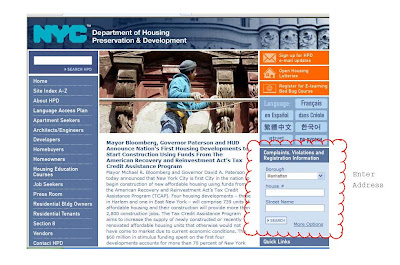 If the property is found in HPD's Database, there will be a series of links listed on the left side of the page. Towards the bottom, there is a link 'I-Card Images'. Click on it:
 If an I-Card is found, it will be listed towards the bottom of the page with a link that says 'View'. Click on it. You may need to install a plug-in when prompted:

That's it, you should see the I-Card, which you can print on your printer, or print to Adobe PDF & save to your computer.
Have a question? E-mail Permitadvisor
Thursday, September 10, 2009
Emergency Escape and Rescue Openings for Residential and Institutional Occupancies
Emergency Escape and Rescue Openings are required in the New NYC Construction Code as per Section BC 1025 in R (Residential) and Group I-1 (Institutional) Occupancies.
Sleeping Rooms below the fourth story above grade shall have at least one emergency escape and rescue opening.
Where below-grade stories contain one or more sleeping rooms, emergency escape and rescue openings shall be required in each sleeping room and shall open directly in to a public street, public alley, yard or court.
- The minimum size of such openings is a minimum net clear opening of 6 square feet.
- The net clear opening height dimension shall not be less than 30"
- The net clear opening width dimension shall not be less than 24"
- The bottom of the clear opening shall not be more than 36" above the floor.
- The opening shall be operational from the inside of the room without the use of keys or tools.
- An emergency escape and rescue opening below the adjacent ground level shall be provided with a window well with a minimum horizontal area of 9 Sq Ft, with a minimum dimension of 36".
- Window wells with a depth of more than 44" shall be equipped with an approved permanent ladder or steps.
There are exceptions listed in the Code under Section 1025.1. The above is an abbreviation/summary of the full Code requirement. Please refer to the Building Code Text for full details.
Have a question? E-mail Permitadvisor
Tuesday, September 08, 2009
2008 Occupancy Group Classifications
Below is a list comparing the 1968 Building Code Occupancy Group Classifications to those of the new NYC Construction Codes
The 1968 Code classified Occupancies in decending order from higher to lower hazard in terms of Life Safety. The 2008 Code classifies Occupancies according to logical reference, where the Occupancy Group Letter matches the Description (ex: R=Residential)
1968 Code -->2008 Code
A-High Hazard-->H-High Hazard (H-1 thru H-5)
B-Storage-->S-Storage (S-1 & S-2)
C-Mercantile-->M-Mercantile-Display and Sale of Merchandise
D-Industrial-->F-Factory and Industrial (F-1 & F-2)
E-Business-->B-Business (Office, Professional, Service-type transaction, Public or Civic Services)
F-Assembly-->A-Assembly (A-1 thru A-5)
G-Education-->E-Educational (5 or more persons)
H-Institutional-->I-Institutional (I-1 thru I-4)
J-Residential-->R-Residential (R-1 thru R-3)
K-Miscellaneous-->U-Utility and Miscellaneous (Accessory Structures or not classified in any specific occupancy)
Description of 2008 Sub-Occupancies:
Assembly:
A-1=Assembly with Fixed seating, intended for production and viewing of the Performance Arts or Motion Pictures.
A-2=Food and/or Drink Consumption.
A-3=Worship, Recreation or Amusement (Physically active), and other assembly uses not classified elsewhere in Group A.
A-4=Indoor Sporting Events with Spectator Seating.
A-5=Participation in or viewing Outdoor Activities.
Factory and Industrial (F):
F-1=Moderate Hazard.
F-2=Involves Non-Combustible, Non-Flammable Materials, or Low-Hazard Production.
High Hazard (H):
H-1=Materials that present a Detonation Hazard.
H-2=Uses Present a Deflagration Hazard or a Hazard from Accelerated Burning.
H-3=Materials that readily support combustion or present a Physical Hazard.
H-4=Materials that are Health Hazards.
H-5=Semiconductor Fabrication Facilities using excessive Hazardous Production Materials (HPM) in excess of the permitted aggregate quantity.
Institutional (I):
I-1=Housing persons, on a 24-hour basis, capable of self-preservation and responding to an emergency situation without physical assistance from staff.
I-2=Medical, Surgical, Nursing, or Custodial Care, on a 24-hour basis, of more than 3 persons who are not capable of self-preservation or responding to an emergency situation without physical assistance from staff.
I-3=More than 5 persons who are detained under restraint or for security reasons.
I-4=Day Care Facilities occupied by persons of any age who receive custodial care (without overnight) by individuals other than parents, guardians, or relatives in a place other than home.
Residential (R):
R-1=Residences occupied Transiently (for less than 1 Month).
R-2=Residences containing more than 2 Dwelling Units and occupied on a Long term basis (for a month or more).
R-3=Residences containing not more than 2 Dwelling Units and occupied on a Long term basis (for a month or more).
Storage (S):
S-1=Moderate Hazard Storage Occupancy for any Flammable or Combustible Materials.
S-2=Low Hazard Storage Occupancy for Non-Combustible Materials.
This list is for informational purposes only. Refer to the 2008 Code Text for the official reading.
Also see the DOB Fact Sheet
Have a question? E-mail Permitadvisor
Tuesday, April 01, 2008
Scissor Stairs

A: A Scissor Stair is a set of 2 interlocking stairways providing two separate paths of egress located within one stairwell enclosure. The Stairs wind around each other, and are separated from each other within the enclosure, by fire rated construction having the same rating as the Stair Enclosure (usually 2-hour construction). Scissor Stairs are permitted under certain conditions by the New NYC Construction Code, as listed below.
Scissor stairs are particularly effective in small footprint Residential Apartment buildings requiring 2 vertical means of egress. In large footprint buildings, Scissor Stairs may create Dead End Corridors, and should be avoided.
Scissor Stairs are permitted in:
'J-2' Residential Apartment Buildings ('R-2' New Const Code).
Per New Construction Code Section 1014.2.1:
- Stair doors must be at least 15 feet apart from each other
- Stair Enclosing Walls shall be Constructed of 2-Hr rated Masonry or approved Masonry Equivalent material.
- Stair may share common walls, floors, ceilings or scissor stairs assemblies or other enclosures provided that the construction separating the stairs is also of at least a 2-hour fire resistance rating and constructed of masonry or masonry equivalent.
- Author’s Note: Comply with Dead End Corridor limitations.
- Author’s Note: Both Stairs within the Scissor Stair enclosure must extend to the Roof to provide Roof Access.
- Author’s Note: When both of the Stairs within a Scissor Stair terminate at a Street Floor Lobby, egress must be provided in 2 separate directions from the Lobby to the Street.
'E' Office Buildings ('B' New Const Code)
Per New Const Code Requirements Section 1014.2.1:
- With a Building Height not exceeding 60 feet
- With a Footprint not exceeding 2,000 sq ft per floor
- Stair doors shall be at least 15 feet apart from each other
- Maximum travel distance of 50 feet from most remote point to a Stair Door
- Stair Enclosing Walls shall be Constructed of 2-Hr rated Masonry or approved Masonry Equivalent material
- Stair may share common walls, floors, ceilings or scissor stairs assemblies or other enclosures provided that the construction separating the stairs is also of at least a 2-hour fire resistance rating and constructed of masonry or masonry equivalent.
Saturday, March 29, 2008
Minimum Trap/Waste Outlet Sizes for Plumbing Fixtures
Q: What are the Minimum Trap/Waste Outlet Sizes for Plumbing Fixtures, the the NYC Building Code?
A: Refer to Table 16-6 for the Minimum Trap Sizes, as restated below:
Fixtures & Trap Sizes:
Bathtub (with or without overhead Shower 1 1/2"
Bidets 1 1/2"
Combination Sink and Wash (Laundry Tray) 2"
Dental Unit or Cuspidor 1 1/2"
Drinking Fountain 1 1/2"
Dishwasher, Commercial 2"
Dishwasher, Domestic 1 1/2"
Floor Drain 3"
Funnel Drain 1 1/2"
Kitchen Sink, Domestic 2"
Laboratory Cup Sink 1 1/2"
Laboratory Sink 2"
Lavatory, Common 1 1/2"
Lavatory, Barber, Beauty Parlor, or Surgeon's 1 1/2"
Lavatory, multiple type (was fountain or sink) 1 1/2"
Laundry Tray (1 or 2 compartments) 1 1/2"
Laundry Standpipe 2"
Shower, Stall 2"
Shower, Gang 3"
Sink (Surgeon's) 1 1/2"
Sink (flushing rim type, flush valve supplies) 3"
Sink (service type with Trap Standard) 3"
Sink, Commercial (Pot, Scullery or sim) 2"
Sterilizers 3"
Urinal (Pedestal) 3"
Urinal (Stall Type) 2"
Urinal (Wall Lip Type) 2"
Urinal (Women's) 3"
Water Closet (Waste Outlet) 3"
Have a question? E-mail Permitadvisor
Wednesday, February 06, 2008
When is a Work Permit Required?
Q: When exactly is a Work Permit required from the NYC Department of Buildings for construction work?
A: The Code allows 'Minor Alterations' and 'Ordinary Repairs' to buildings without the need to obtain a Work Permit provided that it meets their definition of same.
Minor Alterations and Ordinary Repairs do not include the following and therefore require the issuance of a Work Permit:
- Cutting away of any portion of a wall, floor, or roof construction.
- Removal, cutting, or modification of any beams or structural supports.
- Removal, change, or closing of any required means of egress
- Rearrangement or relocation of any parts of the building affecting loading or exit requirements
- Alterations, modifications, replacements, repair or removal of Sprinkler or Standpipe systems.
- Alterations, modifications, replacements, repair or removal of Plumbing or Sewer systems. However, replacement of Plumbing Fixtures on existing Roughing from the inlet side of a trap to any exposed stop valve does not require a Permit.
- Any other work affecting health or the fire or structural safety of the building.
ARTICLE 5 MINOR ALTERATIONS: ORDINARY REPAIRS
27-124 Minor alterations
For the purposes of this code, the term "minor alterations" shall mean minor changes or modifications in a building or any part thereof, excluding additions thereto, that do not in any way affect health or the fire or structural safety of the building. Minor alterations shall not include any of the work described or referred to in section 27-126 of this article, or any other work for which a permit is required under the provisions of articles ten through seventeen of this subchapter.
27-125 Ordinary repairs
For the purposes of this code, the term "ordinary repairs" shall mean replacements or renewals of existing work in a building, or of parts of the service equipment therein, with the same or equivalent materials or equipment parts, that are made in the ordinary course of maintenance and that do not in any way affect health or the fire or structural safety of the building or the safe use and operation of the service equipment therein. Ordinary repairs shall not include any of the work described or referred to in section 27-126 of this article or any other work for which a permit is required under the provisions of articles ten through seventeen of this subchapter.
27-126 Work not constituting minor alterations or ordinary repairs.
(a) For the purposes of this code, minor alterations or ordinary repairs shall not include the cutting away of any wall, floor, or roof construction, or any portion thereof; or the removal, cutting, or modification of any beams or structural supports; or the removal, change, or closing of any required means of egress; or the rearrangement or relocation of any parts of the building affecting loading or exit requirements, or light, heat, ventilation, or elevator requirements; nor shall minor alterations or ordinary repairs include additions to, alterations of, or rearrangement, relocation, replacement, repair or removal of any portion of a standpipe or sprinkler system, water distribution system, house sewer, private sewer, or drainage system, including leaders, or any soil, waste or vent pipe, or any gas distribution system, or any other work affecting health or the fire or structural safety of the building.
(b) Minor alterations or ordinary repairs shall include the repair or replacement of any fixture, piping or faucets from the inlet side of a trap to any exposed stop valve.
Have a question? E-mail PermitadvisorLandmarks Expedited Review
Q: What is the criteria necessary to file for a Landmarks Expedited Review Permit?
A: Landmarks Approval for construction projects can add significant lead time to issuance of a Work Permit. Landmarks offers an Expedited Review process for Alterations meeting the below criteria. We encourage all applicants that can comply with the criteria to submit their application using this method:
1. Must be INTERIOR WORK ONLY;
2. Must be performed ONLY ABOVE THE SECOND STORY;
3. Must NOT be performed on any portion of a space designated as an interior landmark;
4. Must NOT involve any change to, replacement of, or penetration of any window, skylight,
exterior wall or roof of any portion thereof; and
5. For floors 3 through 6 must NOT involve a dropped ceiling or a partition which is less than a
minimum of 1'-0" back from any interior windows sill or frame, whichever is further from the
glass.
Have a question about Landmarks Permits? E-mail Permitadvisor